
Switching between glasses for reading and driving often means juggling multiple pairs all at once, and a disaster if you don’t pack the correct one.
With progressive lenses, clear vision for near, far, and everything in between is achieved in a single, seamless lens. Changes in vision are a common, if frustrating, experience that can be monitored and improved with regular eye exams and innovative solutions, such as progressives, from our team at The Eye Studio by Kennedy Eye Clinic.
A Clearer Look at How Progressive Lenses Work
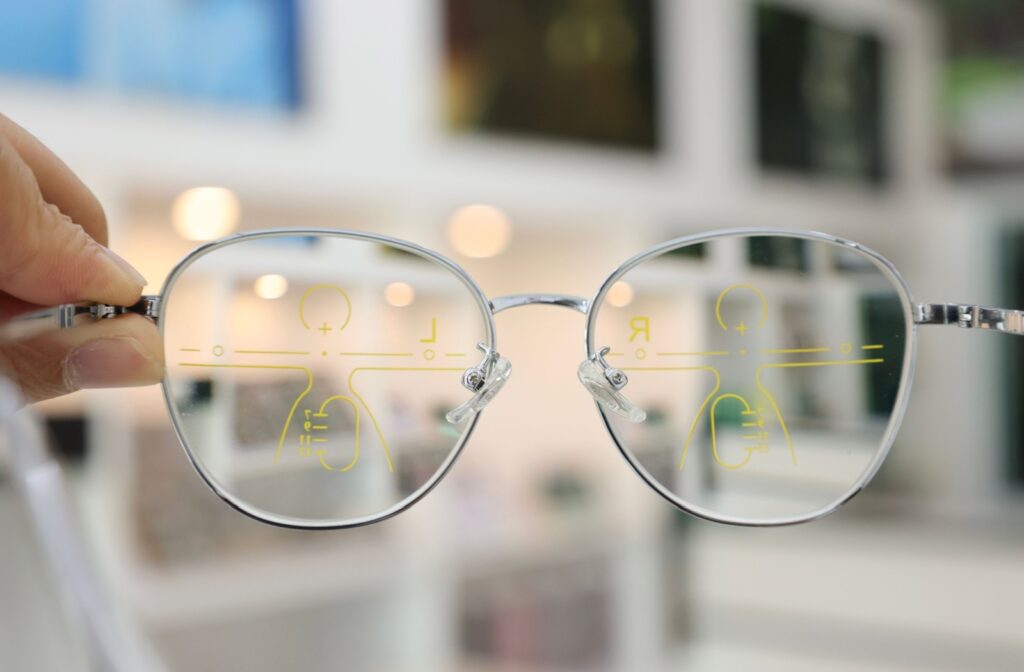
Imagine one pair of glasses that lets you see clearly no matter where you look. That’s the idea behind progressive lenses. They offer a smooth, seamless transition from seeing things in the distance to looking at something up close, with no lines in your lenses to distract you.
How Vision Zones Work
Think of your lens in three parts. You look through the top portion to see things at a distance, like when you’re driving. The middle section helps with intermediate vision for tasks like looking at a computer screen, and the bottom part is for close-up work, such as reading a book.
Progressives vs. Bifocals & Trifocals
Unlike bifocal or trifocal lenses, progressives have no visible lines. This provides a more natural and gradual shift in focus. With older, lined lenses, objects can seem to “jump” as your eyes move across the line; progressive lenses remove that sudden change.
Could You Benefit from Progressive Lenses?
As you move into your 40s and beyond, it’s common to experience a natural change in vision called presbyopia, making it harder to focus on objects up close. Progressive lenses are a popular solution for this very common part of life.
Signs You Might Notice
- Holding books or your phone farther away to read them
- Needing more light for close-up tasks
- Frequent headaches or eye strain from reading
- Blurry vision when you switch focus from near to far
Bust the Myth: Adjust to Your First Progressives with Ease
You may have heard that progressive lenses are hard to get used to, but innovative lens design has made the adjustment period much shorter and easier for most people. It also helps to know that, despite some myths, eyeglasses help keep your vision in focus, not weaken it.
What to Expect at First
For the first few days, you may notice some softness at the edges of your vision. This is normal as your eyes learn to use the different zones in the lens. The key is to wear them consistently to help you adapt more quickly.
Tips for a Smooth Transition
- Point your nose: Look directly at an object and point your nose toward it. Then, move your chin up or down until the image comes into focus.
- Mind your step: When you walk up or down stairs, tuck your chin so you’re looking through the top distance part of your lenses.
- Position your screen: If you use a computer, adjust your monitor so you look through the middle of the lenses for clear, comfortable vision.
Modern Lens Tech & Custom Fits
Lens technology has come a long way. Newer lens designs are designed to provide wider fields of vision and a more comfortable experience. A key part of success is a lens designed just for you and your daily needs.
A Look at Innovative Lens Designs
Hoya’s portfolio, for example, offers specific innovations. Their iD Technology uses a dual-surface approach with vertical powers on the front of the lens and horizontal powers on the back. This design creates wider viewing fields and makes transitions from far to near viewing feel more natural. Another feature, binocular harmonization technology (BHT), balances the prescription between your right and left eyes for more stable vision.
Tailored for Your Lifestyle
Your lenses can be personalized to your lifestyle. If you spend a lot of time outdoors, work at a computer for hours, or love to read, the lens design can be adapted to support your daily activities. This level of customization, which relies on precise measurements from your eye care team, is not something you typically find with online retailers or in big-box stores.

Find Your Focus with a Personalized Fit
The success of your progressive lenses depends heavily on the fit. Accurate measurements are needed to ensure the different vision zones align with your eyes, providing clear, comfortable vision at every distance. An optician in Saskatoon can take these detailed measurements and discuss your lifestyle to recommend a lens design that works for you. The team at The Eye Studio by Kennedy Eye Clinic is here to help you find a personalized solution for your vision. Schedule your appointment to explore your options.